
How Spectroscopy Is Revolutionizing Modern Research
Release time: 2025-12-24
Inhaltsverzeichnis
Spectroscopy is a powerful analytical technique that has transformed the landscape of modern research across various scientific disciplines. By studying the interaction between light and matter, spectroscopy enables researchers to gain invaluable insights into the composition, structure, and dynamics of materials. This article delves into what spectroscopy is, how it works, the various types of spectroscopy, and the instruments used in these techniques.
What Is Spectroscopy?
Spectroscopy is the study of the interaction of electromagnetic radiation (such as light) with matter. It encompasses a range of techniques that allow scientists to analyze the spectral data derived from a sample when it absorbs, emits, or scatters light. The fundamental principle behind spectroscopy is that different materials interact with light in unique ways, producing distinct spectra. These spectra serve as “fingerprints” that can be used to identify substances, determine their concentration, and explore their physical and chemical properties.
The applications of spectroscopy are vast and varied, including fields such as chemistry, physics, biology, environmental science, and even astronomy. As a result, this technique has become an essential tool in both research and industrial settings, aiding scientists in their quest to solve complex problems and discover new phenomena.
Wie funktioniert die Spektroskopie?
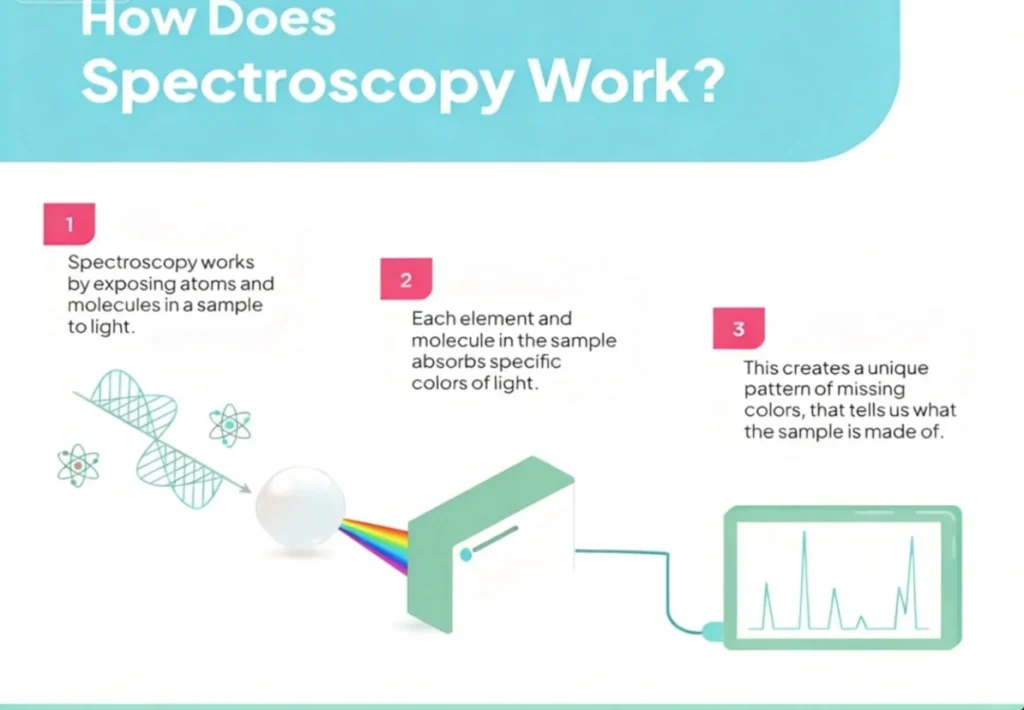
The working principle of spectroscopy revolves around the interaction of light with matter. When light encounters a substance, several processes can occur: absorption, emission, or scattering. Each process provides different information about the material being studied.
- Absorption: When light passes through a substance, certain wavelengths may be absorbed by the material, causing electrons within the atoms or molecules to move to higher energy levels. The specific wavelengths absorbed depend on the material’s unique electronic structure.
- Emission: After absorbing energy, some materials can release that energy in the form of light when the electrons return to their original energy levels. This emitted light can be measured and analyzed to provide information about the substance.
- Scattering: Light can also scatter when it interacts with particles in a sample. The change in direction and energy of the scattered light can reveal information about the size, shape, and composition of the particles.
By capturing and analyzing the resulting spectra—graphs that plot intensity against wavelength—researchers can deduce important details about the sample, such as its molecular structure, chemical composition, and concentration.
Arten der Spektroskopie
There are several types of spectroscopy, each tailored to specific applications and providing unique insights into the properties of materials. Some of the most commonly used types include:
- Infrared (IR) Spectroscopy: This technique measures the absorption of infrared light by a sample, providing information about molecular vibrations and functional groups. IR spectroscopy is widely used in organic chemistry to identify compounds and study chemical bonds.
- Ultraviolet-Visible (UV-Vis) Spectroscopy: UV-Vis-Spektroskopie involves measuring the absorption of ultraviolet or visible light by a sample. It is particularly useful for studying electronic transitions in molecules and is commonly employed in quantitative analysis and pigment studies.
- Nuclear Magnetic Resonance (NMR) Spectroscopy: NMR spectroscopy uses magnetic fields and radiofrequency radiation to investigate the environments of nuclei in a sample. It is invaluable for determining the structure of organic compounds and studying interactions in biological systems.
- Mass Spectrometry (MS): Although not a traditional spectroscopy technique, mass spectrometry analyzes ionized particles based on their mass-to-charge ratio. When combined with other spectroscopic methods, it provides comprehensive data about molecular structures and compositions.
- Raman-Spektroskopie: Raman-Spektroskopie relies on inelastic scattering of monochromatic light to provide information about molecular vibrations. It is particularly useful for studying molecular structures and chemical bonding in solids, liquids, and gases.
- Fluorescence Spectroscopy: This technique detects the fluorescence emitted by a sample after it has absorbed light. Fluorescence spectroscopy is widely used in biological research for imaging and quantifying biomolecules.
What Instruments Are Used in Spectroscopy?
The choice of instrument in spectroscopy largely depends on the type of spectroscopy being employed and the specific requirements of the experiment. Here are some key instruments commonly used in various spectroscopic techniques:
- Spectrophotometers: These devices measure the intensity of light at different wavelengths. They are used in UV-Vis and IR spectroscopy to analyze the absorption spectra of samples.
- NMR Spectrometers: NMR spectrometers generate strong magnetic fields to analyze samples at the atomic level. They are crucial for structural determination in organic chemistry and biochemistry.
- Mass Spectrometers: Mass spectrometers ionize chemical species and measure their mass-to-charge ratios, providing detailed information about molecular weight and structure.
- Raman-Spektrometer: These instruments are designed to measure the inelastic scattering of light, enabling the analysis of molecular vibrations and chemical compositions.
- Fluorescence Microscope Systems: These specialized microscopes combine optical microscopy with fluorescence spectroscopy, allowing researchers to visualize and quantify fluorescently labeled samples.
- Fourier Transform Infrared (FTIR) Spectrometers: FTIR spectrometers use Fourier transform techniques to enhance the resolution and sensitivity of infrared measurements, making them ideal for complex mixtures.
The Vital Role of Spectroscopy
Spectroscopy is a revolutionary analytical technique that has transformed modern research across various scientific fields. By enabling scientists to probe the interactions between light and matter, it provides critical insights into the composition, structure, and dynamics of substances. From chemistry and biology to environmental science and astronomy, the diverse applications of spectroscopy continue to expand, driving innovation and discovery. As technology advances, the development of new spectroscopic techniques and instruments will further enhance our ability to analyze and understand the world around us, solidifying spectroscopy’s role as a cornerstone of modern research.
Häufig gestellte Fragen
Whether you are an experienced professional in the labs or research institutions or newcomer,our FAQ guide provides valuable insights and practical advice according to your needs.
What is the basic principle of spectroscopy?
Spectroscopy is based on the interaction between light and matter, allowing scientists to analyze the resulting spectra to gain insights into the properties of materials.
What are the different types of spectroscopy?
Common types include infrared (IR) spectroscopy, ultraviolet-visible (UV-Vis) spectroscopy, nuclear magnetic resonance (NMR) spectroscopy, mass spectrometry (MS), Raman spectroscopy, and fluorescence spectroscopy.
How is spectroscopy used in biological research?
Spectroscopy is used to study biomolecules, visualize cellular processes, and enhance medical diagnostics through techniques like fluorescence spectroscopy.
What instruments are commonly used in spectroscopy?
Key instruments include spectrophotometers, NMR spectrometers, mass spectrometers, Raman spectrometers, fluorescence microscopes, and FTIR spectrometers.
Why is spectroscopy important for environmental monitoring?
Spectroscopy allows for the detection and quantification of pollutants, helping researchers assess ecosystem health and address environmental concerns.